Background and Rationale
The activity on the Writing, Dissemination, and Presentation of Policy and Advocacy Briefs on Climate Adaptation Strategies and Project Impact for Rice Production was conducted as part of the RICOWAS project’s implementation plan. The activity aligns with the project’s objective of strengthening communication and policy advocacy on climate-resilient rice production systems in Sierra Leone.
Climate change continues to pose significant challenges to rice production. Therefore, the development of policy briefs and advocacy materials helps inform policymakers, researchers, and extension services about adaptive practices and technologies that enhance resilience in the rice sector.
Objectives
- To develop and produce concise and evidence-based policy and advocacy briefs on climate adaptation in rice production.
- To disseminate the policy briefs to key stakeholders, including policymakers, researchers, and farmer organizations.
- To enhance knowledge sharing and policy dialogue around RICOWAS project impacts and adaptive strategies.
- To promote informed decision-making and institutional support for scaling climate-smart rice technologies.
Target Audience
The activity primarily targeted
- Policymakers from the Ministry of Agriculture and Food Security (MAFS)
- SLARI management and technical staff
- Development partners
- Farmer-based organizations (FBOs)
Methodology
The implementation followed a multi-step approach
- Drafting: Policy and advocacy briefs were developed using research outputs and field data from RICOWAS demonstration sites.
- Review and Validation: Drafts were reviewed internally and validated by the Communications and Knowledge Management Unit in consultation with project coordinators.
- Design and Dissemination: The final briefs were designed in institutional formats and disseminated both electronically and in print.
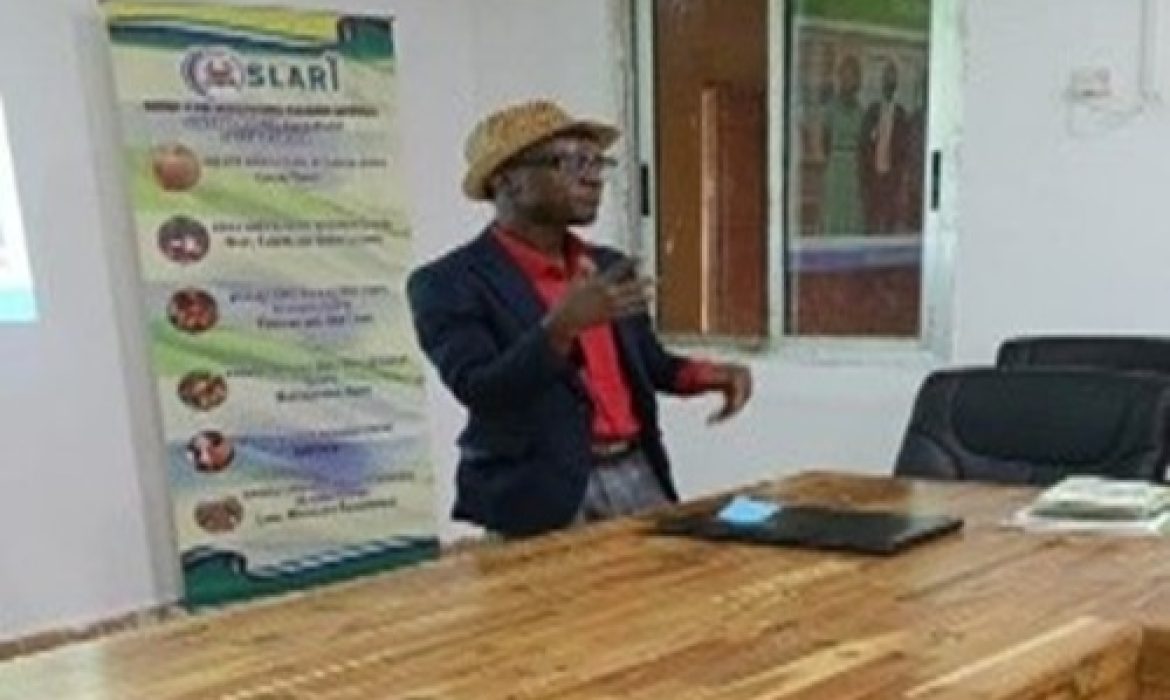
- Presentation: A dissemination and presentation session was held with key stakeholders to share insights and collect feedback.
Expected Outputs
- At least three policy and advocacy briefs produced and validated.
- Dissemination of briefs through institutional channels and partner networks.
- Strengthened awareness among policymakers and practitioners on climate-resilient rice production.
- Enhanced visibility of SLARI and RICOWAS project interventions.
Challenges
- Limited financial resources delayed the initial implementation schedule.
- Coordination with multiple partners required additional time for validation.
- Need for further capacity building in policy brief writing and layout design.
Conclusion and Recommendations
The implementation of Activity 3.1.1.5 contributed significantly to promoting evidence-based communication and advocacy in support of climate-resilient rice production. The activity also enhanced stakeholder engagement and visibility for the RICOWAS project.
Recommendations
- Strengthen institutional capacity for continuous production of policy and advocacy briefs.
- Increase budgetary allocation for communication and dissemination activities.
- Foster closer collaboration between SLARI, MAFS, and media partners to sustain advocacy efforts.
Related Posts

Component 3
Development of a Communication Strategy and Plan (Activity 3.1.1.1). Report on the Administration of the Communication Needs Assessment...
Production of documents, videos, radio shows, maps. (Activity 3.1.1.3)
Introduction This report presents a summary of the implementation of Activity 3.1.1.3 under the RICOWAS Project, as contained in SLARI’s work...